


In this comprehensive scientific article, ENT doctor Jan Rombout, Registered Nurse Meg Bumpstead and ENT doctor Jurgen P. te Rijdt, MD compare the two methods of cleaning ears.
Enter your email address below to download the article in PDF.
Summary
Dry Ear Canal Cleaning (DECC) using instrumental removal techniques (with the microsuction pump and/or curettage) under direct binocular view have proven to be faster, safer, more effective and more appropriate for a wider range of patients. Currently, Dry Ear Canal Cleaning (DECC) is the ENT doctors’ gold standard for earwax removal.
Many health professionals still use the old-fashioned method of earwax removal: irrigation or blowing out. This article aims to raise awareness regarding recent developments that make DGR more accessible.
Recent innovations in micro-suction equipment and forehead-worn microscopes allow for a cost-effective transition for entrepreneurs on a tight budget. Quality training combines e-learning and hands-on learning to minimize training time.
These developments allow organizations involved in syringing to begin manual removal to reduce risks, improve patient comfort, and help a wider range of patients more effectively.
Also Hearing Care Professionals not yet active in earwax removal can begin using DGR to provide more care and better quality.

Direct binocular view combined with microsuction increases effectiveness
Ear syringing or irrigation is no longer a recommended or supported technique for earwax removal, according to the 2017 US Clinical Practice Guideline Earwax (Cerumen Impaction) and the 2023 UK NICE Clinical Knowledge Summary.
With syringing, earwax is sometimes left behind, requiring the client to return for secondary or tertiary treatment.
Without direct vision, it is unclear to the professional what the effect of the irrigation is. During DGR with microsuction, the professional always has direct vision of the ear canal with both eyes. This allows all earwax to be removed, this ensures effective treatment, saving both patient and professional repeat visits.
Spraying out does not remove impacted (plugged) earwax. By combining microsuction with curettage, DGR is effective in most cases and provides a more certain, better result.
In one study, the success rate of cerumen impaction removal with syringe was only 70%. Success rates for DGR with a forehead-borne microscope were significantly higher at 90%.
Inserting pressurized water into the ear is an unnecessary risk factor
In various studies, syringing the ear canal with tap water is a risk factor that can lead to ear infections and eardrum perforation in certain patient types.
The main reason for complications is the buildup of water pressure when the syringe blocks the entrance: water can enter the ear canal and have difficulty escaping, leading to high pressure and a possible eardrum rupture.
ENT surgeons in the Netherlands used to flush out ears with water, but this is no longer done because of the potential complications. Modern ENT treatment units do not even have a water applicator anymore.
Nevertheless, ear syringing is still common in many general practices. In practice, the treatment itself is usually outsourced to the GP medical assistant.
About 40% of 300 general practitioners who performed irrigation for earwax removal reported medical complications. In Australia, 20% of claims for medical negligence at GP practices related to earwax removed by irrigation.
DGR without water is less likely to lead to secondary infection. It also does not exert pressure on the ear canal or eardrum, eliminating the risk of dizziness, nausea and perforation. Also, the absence of water makes it less messy and a more pleasant experience.
DGR under direct vision is also the only safe method for earwax removal when it cannot be assessed whether the eardrum is intact, prior to earwax removal. If pressurized water is introduced in an undiagnosed perforation, it can cause disruption of the delicate ossicles (small bones in the middle ear that are essential for hearing), which can lead to hearing loss.


Photos above: Two images of the same plugged ear wax with some yellow yeast. The first picture was taken before and the second after the ear was spat out; The physician’s assistant was convinced that the ear canal was clean and reported a normal eardrum after the procedure. However, the blowing out loosened some skin sheets, which were misinterpreted as the eardrum because of its grayish glistening aspect. The water also spread the yeast through the ear canal and is also present on the skin of the ear canal in the second photo.
DGR is faster and saves time for everyone
Earwax removal by microsuction under direct vision of a head-worn 3D microscope, is a short procedure of 5 to 10 minutes. In addition, the direct 3D view allows for better recognition and early detection of pathology, which can be adequately addressed or referred to a primary care or ENT physician.
Combined with the higher effectiveness, this leads to a very positive outcome for both patient and practitioner.


The photos above are two video images of the same ear, one on the left with impacted earwax and one on the right after cleaning with microsuction.
By offering DGR, more patients can be treated
Direct 3D vision is essential for the safe removal of earwax.
There are several situations in which irrigation can lead to serious complications, and manual earwax removal is strongly recommended in these cases:
- A history of previous problem with irrigation (pain, perforation, dizziness);
- Current or history of eardrum perforation;
- Tubes are present;
- An ear surgery in history (excluding tubes, more than 18 months ago, with subsequent discharge from an ENT department);
- Mucous discharge from the ear (which may indicate an undiagnosed perforation) within the past 12 months;
- History of middle ear infection in the past six weeks;
- Acute otitis externa with an edematous ear canal and painful auricle;
- Presence of a foreign body, including plant material, in the ear; hygroscopic material, such as peas or lentils, will expand on contact with water, making removal more difficult;
- Cleft palate, whether repaired or not;
- If the ear to be treated is the only hearing ear, because there is a small chance that irrigation can cause permanent deafness;
- Agitation because the patient may not be able to sit still;
- Patients with difficulty speaking, for example, young children and some people with dementia or learning disabilities.
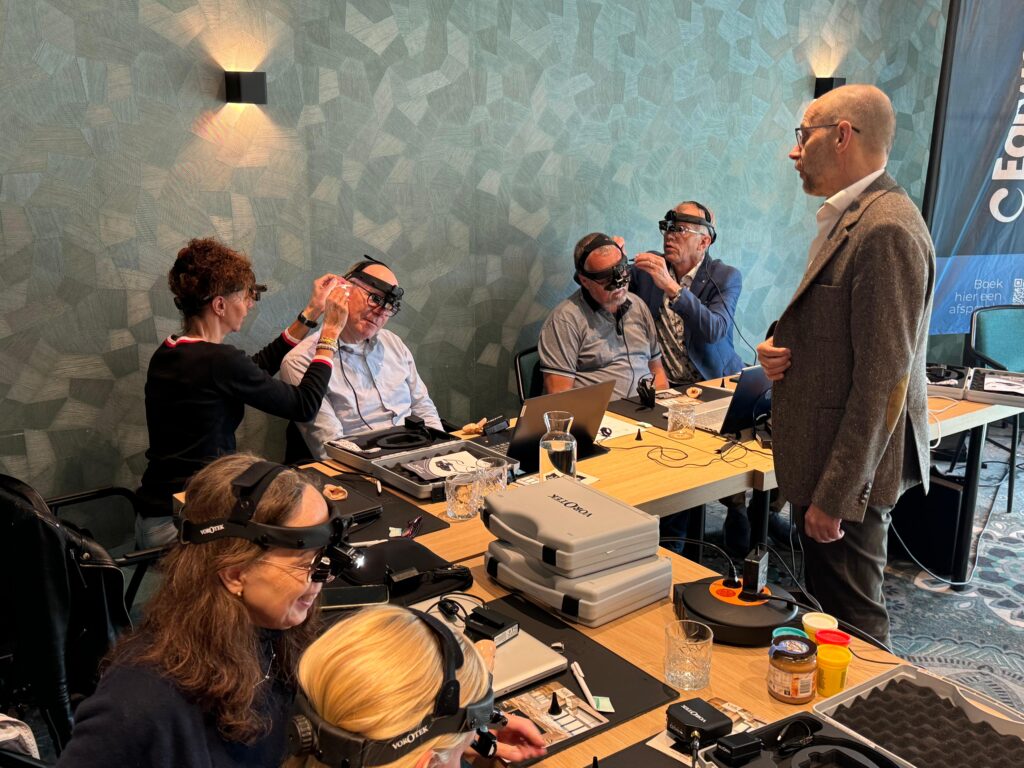
Invest to reduce risk of pain and save everyone time
Safe and effective ear wax removal depends on health care providers using optical equipment to accurately assess small distances in the ear canal. This is known as “Depth Perception.”
The use of the forehead-worn binocular microscope provides excellent depth perception (3D vision) through unique converged optical paths, allowing both eyes to see the ear canal and the eardrum.
It is a common misconception that traditional magnifying loupes or a video otoscope provide good depth perception.
These devices have monocular optical paths that do not provide good depth perception in the ear canal, making it impossible to accurately estimate small distances and resulting in a less safe working environment.
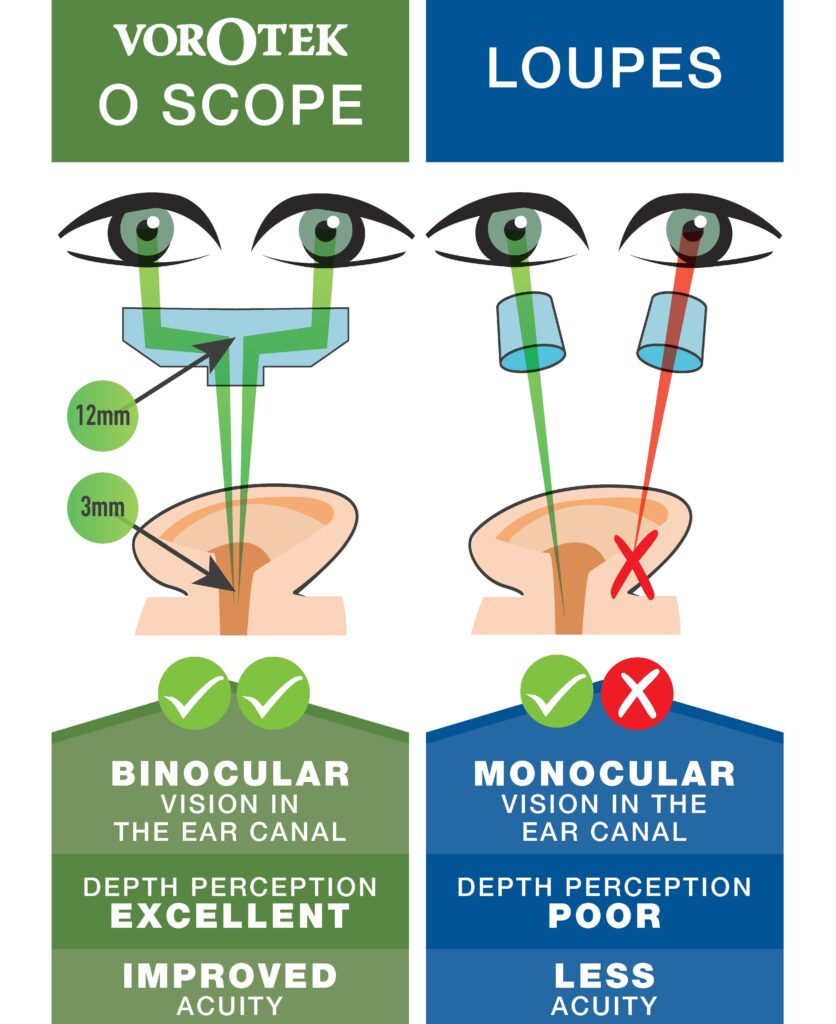
In the illustration:
The Vorotek O Scope is a unique head-worn microscope frequently used in Australia by ENT doctors alongside — or as a mobile alternative to — their larger fixed (operating) microscopes.
The Vorotek O Scope virtually reduces the interpupillary distance (IPD), allowing one to look through a narrow channel such as an ear canal or nose with both eyes instead of one, to improve depth perception and thus increase patient safety.
In addition to using the correct optical equipment, DECC via microsuction and curettage requires investment in high-quality suction equipment and instruments, and it is important that a well-trained, experienced professional performs the procedure.
Training that does not interrupt business operations
Education and protocols cover the complete anatomy of the ear, knowledge of ear disorders and pathophysiology, precautions to be taken, practice, documentation and recording of treatment, education to – and consent of – the client, and dealing with potential awkward situations and poor outcomes.
High-quality, cost-effective and time-saving DECC training is now available as a combination of e-learning, practical hands-on training and remote ENT supervision, minimizing business interruption.
The benefits of an investment in DGR to replace irrigation include a lower risk profile, more effective and faster earwax removal for a wider range of patients, better and more accurate pathology recognition, and a more pleasant patient experience.
All this leads to higher quality ear care and reduced pressure on primary and secondary care.
References
Seth R. Schwartz, MD, MPH, Anthony E. Magit, MD, MPH, Richard M. Rosenfeld, MD, MPH. The American Association of Otolaryngology, Head and Neck Surgery Foundation -. Clinical Practice Guideline (Update): Earwax (Cerumen Impaction)., 2017, Vol. 156(1S) S1-S29
NICE – National Institute for Health and Care Excellence. Hearing Loss in Adults: Assessment and management; Nice Guidelines NG98 Methods, Evidence and Recommendations., June 2018 (updated October 2023)
Disclaimer
ENT doctor Dr. Jan Rombout is the owner/founder of OnlineKNO-arts, which offers ENT services outside the hospital setting. To ease the burden on the healthcare system, he also offers best-practice training for DECC and ENT supervision to Hearing Care Professionals, audiologists, and physician assistants through a partnership with Alsoka Medical in the Netherlands.
RN Meg Bumpstead was previously co-founder and co-owner of eight highly successful ear surgery clinics in Australia, which she ran from available ENT treatment rooms. She is the founder and owner of the ClearEars Institute, which provides a top-quality e-learning environment for DGR through Alsoka Medical and others in Europe.
Alsoka Medical supplies Vorotek forehead-worn 3D microscopes and microsuction pumps and facilitates training, ENT supervision, and lead generation for Hearing Care Professionals who remove earwax using the dry method via the EarwaxShop.
Frequently asked questions
Dry Ear Canal Cleaning (DECC) is the removal of earwax without water: using microsuction and/or curettage, under direct binocular view. For this, you use equipment such as the Vorotek O Scope and the Alsoka Medical microsuction pump.
With DECC, you see exactly what you are doing and no pressurized water enters the ear canal. As a result, the risk of damage to the ear canal or the eardrum and the risk of inflammation is lower, making the method suitable for a broader group of clients.
Syringing is discouraged in cases of a (previously) perforated eardrum, tympanostomy tubes, previous ear surgery, or an inflamed ear canal. With DECC under direct view, a trained professional can work safely in many of these situations, or recognize in time that a referral is necessary.
In our Dry Ear Canal Cleaning (DECC) training, you will learn the theory and practice of microsuction and curettage, taught by ENT doctors, with remote supervision provided after the training.
Yes. Enter your email address at the top of this page to receive the scientific article as a PDF.