


Safe ear suctioning by the Physician assistant with the Vorotek O Scope
Ear suctioning has recently come within reach for you as an assistant to the ENT doctor or assistant to the General practitioner.
Work with less risk, applicable in more situations, less hassle and mess, works faster, and is much more pleasant for you and your patient.
The head-worn microscope, the Vorotek O Scope, makes it possible: much easier to work with and available for a small investment.
In addition to equipment, we offer you tailor-made training by the ENT doctor so that you can get to work with confidence.
By the way, our training course “Dry Ear Canal Cleaning (DECC) for the Physician assistant” is accredited by KABIZ-DA and the NVDA with 41.5 points.
Relieve the ENT doctor and enrich your own job
Fear of working with the large fixed operating microscope of the ENT doctor? That is now a thing of the past with the Vorotek O Scope, a head-worn microscope. You put it on, adjust it to your interpupillary distance (IPD), and you can get to work. Always a sharp image and both hands free for instrumenting. Wonderfully mobile, and you easily adapt to the posture of your patient.
Support your ENT doctor and take over some of his or her tasks, thereby enriching your own job. Convince the ENT doctors in your department with the information on the ENT specialist page or request the Business Case for the ENT Physician assistant.

Switch to ear suctioning in your general practice
The advantages of ear suctioning compared to syringing are enormous and it is truly within reach now. Enrich your job with this fine, modern way of earwax removal.
Convince the general practitioners in your practice with the information on the special General practitioner specialist page or request our special Business Case for General Practitioners.
Dry Ear Canal Cleaning (DECC) at the ENT outpatient clinic
There is a growing shortage of ENT doctors, while the demand for care is increasing due to the aging population. Part of the ENT doctor’s work consists of cleaning ears and then assessing whether additional treatment is necessary. A trained physician assistant at the ENT clinic can perform simple DECC independently; the ENT doctor then only assesses the ear.
This approach was developed by ENT doctor Dr. Jan Rombout (Online ENT doctor and Zaans Medical Center) and René Kamminga (Alsoka Medical and EarwaxShop).
The benefits for the ENT clinic
- More time for the ENT doctor for patients with more complex pathology.
- Immediate earwax removal during the intake for audiometry: this saves a separate ENT outpatient visit.
- More emergency slots for blocked ears. Due to long waiting times, patients with a blocked ear are sometimes socially handicapped for weeks or even months.
- Enrichment of the work of the physician assistant; this helps in retaining and attracting staff.
- A minimal investment: the head-worn Vorotek O Scope is mobile, hands-free, and not sensitive to movement, unlike the large fixed microscope at the clinic.
How to set up an earwax clinic
- Start labeling a few months in advance. The ENT doctor assesses which patients are suitable for DECC by the physician assistant: a normal ear canal cleaning, no radical cavities, and no chronic inflammation of the eardrum or attic.
- Schedule the labeled patients for a separate earwax clinic with the physician assistant.
- Help known patients urgently if their ear suddenly becomes completely blocked. This increases the service level for these patients.
Supervision by the ENT doctor
Each patient is briefly assessed by the ENT doctor after the DECC. Such an assessment takes 1 to 2 minutes and saves time compared to a full ENT consultation. A 10-minute supervision slot during the ENT clinic is sufficient for three treatments by the physician assistant in the room next door (initially two).
The two-room system: one ENT doctor, two rooms
With an earwax clinic next to the ENT doctor’s consultation room, a two-room system is created that increases productivity. The time savings are found in:
- Cleaning time which no longer falls within the ENT doctor’s time.
- Changeover times: if a patient with a walker needs a moment to sit safely in the treatment chair and leave again, that time now falls under the physician assistant.
- No separate ENT outpatient visit required before audiometry to check for earwax.
- Administration: the physician assistant handles the administration and documents the ENT doctor’s assessment.

Earwax removal: a skill that enriches your work as a physician assistant
With the Vorotek O Scope, you view the entire ear canal yourself, with both eyes and in 3D. You see for yourself if and how much earwax there is, what you are doing, and whether your treatment has had the desired result. This means you no longer have to pass this treatment on to the doctor or to a follow-up appointment: you perform it independently, from assessment to result.
That provides variety in your tasks and a piece of personal responsibility. You are not just being supportive, but completing a full treatment yourself. Patients also experience having their ears suctioned as a pleasant treatment, and you are the one who makes that result immediately visible: a patient who walks out the door with fewer complaints, thanks to your actions.
Do you also want to know the broader practice benefits such as fewer referrals, fewer follow-up appointments, and satisfied customers? You can find that business case per specialty on the pages for the general practitioner and the ENT doctor.
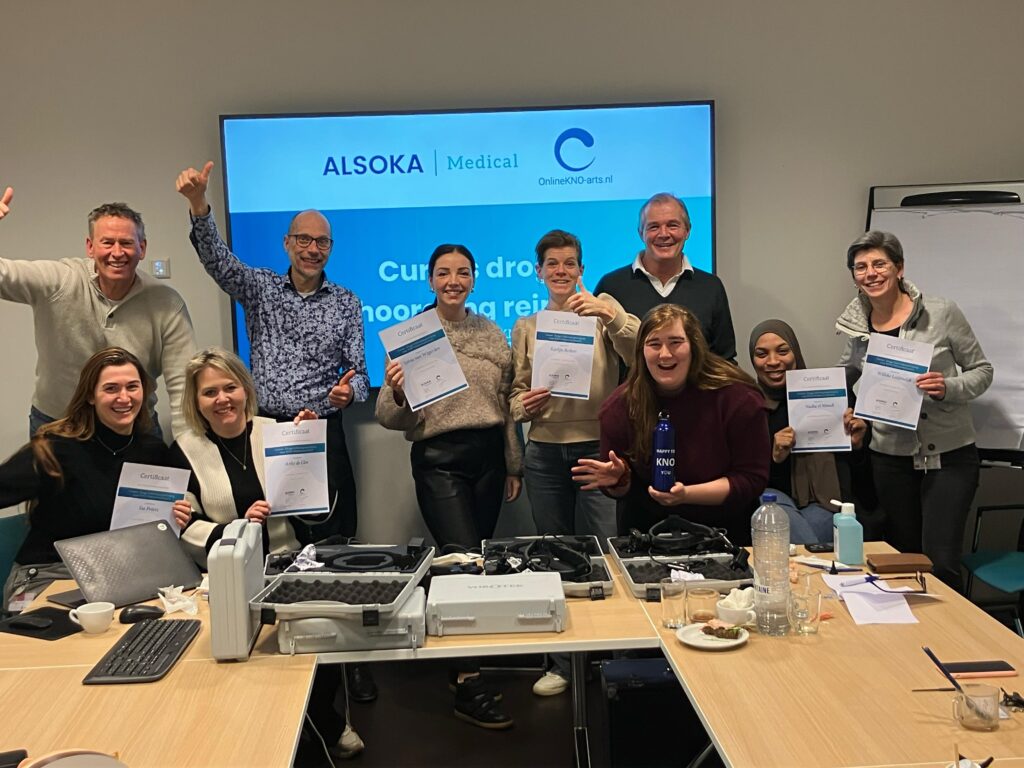
Learn to remove earwax with microsuction in a safe and confident way
In addition to equipment, we also provide training given by ENT doctors, possibly on-site if the group size is sufficient.
This offers great advantages for you as a Physician assistant: We are true experts in earwax removal using microsuction and have developed a standard approach that works. Earwax removal is not actually part of the training for an ENT doctor, and every doctor therefore maintains their own way of working. Furthermore, in our experience, a patient will accept some pain from a doctor. With an assistant, this is different, and more caution is required.
We notice that physician assistants greatly appreciate being taught a standard way of working and that time is taken to build confidence. Therefore, come to us for training.
Do you find it difficult to raise this subject with your boss and convince them to take this step? We help you compile a business case that you can use yourself in your conversations.
Click through below to our offerings that fit your specialty:

Vorotek O Scope
The Vorotek O Scope is a unique head-worn binocular microscope that allows you to see and perform procedures in 3D deep within narrow canals such as the nose and ear.

Microsuction Pumps

Extended e-Learning Module Ear Anatomy, Physiology, Pathology & Introduction to Working Safely in the Ear canal
KABIZ-DA accredited with 35 points
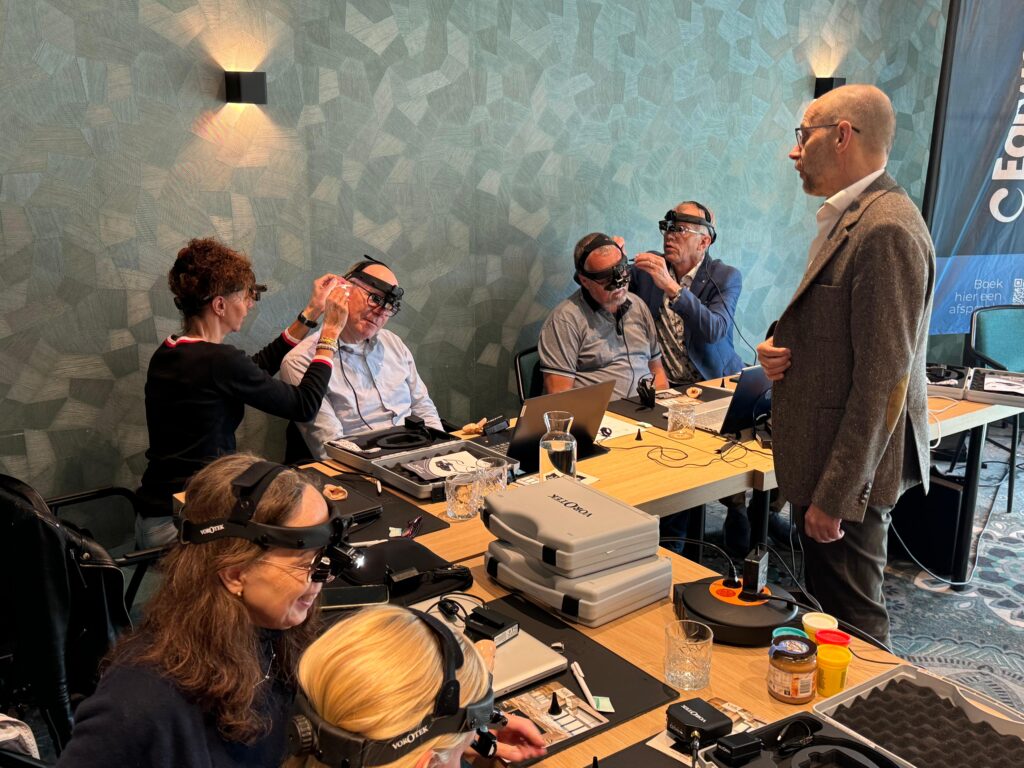
Practical Day Early Recognition of Ear Pathology and Working Safely in the Ear Canal with the 3D microscope
KABIZ-DA accredited with 6.5 points

Ear Care Products
Here you will find ear care products such as ear drops based on special oils, thyme, and oregano to soften earwax

Accessories
Click through to all accessories and parts for Vorotek Optical Aids and Microsuction Pumps here

Instruments & Disposables
Everything needed to clean ears with microsuction and curettage and to remove cerumen.

Vorotek M Scope
The Vorotek M Scope is specially designed for medical specialists who want a good overview with slight magnification of the area to be treated.
Frequently asked questions
What are the benefits for the ENT doctor if I start removing earwax as a physician assistant?
ENT doctors are getting busier and waiting lists are growing. Patients with non-complex ear canals can be selected for treatment by you as a physician assistant. This relieves the limited capacity of the ENT doctor for more complex cases. Furthermore, the ENT doctor benefits from you as a physician assistant being satisfied and getting a lot of pleasure out of your work.
What are the benefits for our general practice if we switch to earwax suctioning?
Suctioning is the pleasant way to remove earwax. For you and your patient. It takes less time, creates less mess, and results in happier patients. See the General Practitioners Page for more detail.
Is the training accredited in the Netherlands?
By the way, our training course “Dry Ear Canal Cleaning (DECC) for the Physician assistant” is accredited by KABIZ-DA and the NVDA with 41.5 points.
Which training do I follow as a Physician assistant?
The accredited Dry Ear Canal Cleaning (DECC) training for General Practitioners and Physician assistants, including theory and practice, taught by ENT doctors.
What equipment do I need?
The Vorotek O Scope head-worn microscope, the Alsoka Medical Microsuction pump and suction tubes, ear specula, and instruments.
Why ear suction instead of ear syringing?
With ear suction, no water enters the ear canal and you work under direct vision. This results in fewer risks and is more pleasant for the patient. Read more about Dry Ear Canal Cleaning (DECC) versus ear syringing.
What do I do if I see something abnormal in the ear?
Then you stop the treatment and consult with the General Practitioner, who will refer to the ENT doctor if necessary.
In which language is the manual?
The instructions for use are in English. Our products are intended exclusively for professional use by trained healthcare professionals.
How do we set up an earwax clinic at the ENT outpatient department?
Start a few months in advance: the ENT doctor labels the patients who are suitable for DECC by the physician assistant. You then schedule those patients for a separate earwax clinic. In addition, you can provide urgent help to known patients with a suddenly blocked ear.
Which patients are suitable for DECC by the physician assistant?
Patients for whom the ENT doctor expects a normal ear canal cleaning, without radical cavities and without chronic inflammation of the eardrum or attic.
How does supervision by the ENT doctor work?
After the DECC, the ENT doctor briefly assesses each patient in 1 to 2 minutes. A 10-minute supervision slot during the ENT clinic is sufficient for three treatments by the physician assistant (initially two).